Monday, December 5, 2011

Chole Chaat...


Well, I’ve been eating lunch at the hot bar quite a bit recently, and as you may recall the last time I was frequenting the salad/hot bar I discovered the awesomeness that is Tomato Bhaji and Kale. This time around I’ve discovered something just as awesome Chole Chaat, which is another Indian dish.

Generally speaking I don’t like to buy lunch during my work day. I prefer to bring lunch from home and save myself the money. Also this way I can ensure that I’m definitely getting a lunch that’s nutritious rather then just convenient. However because of the crazy business of the holiday season I’ve found myself over the past few weeks with less and less time (not to mention energy) to prepare lunch meals in advance. Thankfully I discovered Chole Chaat, which has been a true lifesaver. Not only is it mind-blowingly delicious it’s also low calorie, and absolutely packed with protein and fiber which is perfect for getting you through those long hard days.


When I saw it initially on my first circle around the hot bar I was less then impressed. It just didn’t look all that appetizing to me to see a bunch of chickpeas floating around in a thick yellow-red sauce. However upon circling around a second time I realized there really wasn’t anything at all that I found to appetizing and so I gave the Chaat a skeptical second look. I read the ingredients on the tag and discovered they were all things that I liked, so with my belly grumbling with hunger and a total lack of something more visually appealing I decided to bite the bullet and plop a few spoonfuls into my bowl.

How amazed was I when I took that first bite? Wow - there are not words to describe it. The dish was absolutely phenomenal. It had a nice heat, not too spicy, a little bit of sweet, a hint of curry, and just an all around grand robust flavor. I gobbled it up and wanted more. I have since got this dish from the hot bar six times, and after about the fifth I decided it was time I write down the ingredients and re-create the dish myself. It’s a good thing I took that initiative by the way, because the food at the hot bar is always in rotation meaning the same thing is rarely there for long periods of time, and this week I happened to see that Chole Chaat was absent from the hot bar. No matter though, armed with my handy-dandy hand scrawled list I decided to embark on re-creating this tastebud tantalizing dish Friday afternoon. The only problem was what quantities should I use?


Now, I did a quick Google search for Chole Chaat, and several recipes popped up. However like with my Tomato Bhaji debacle none of them entirely matched the ingredient list I had in my hand. Many of the online recipes included ingredients not on my list, and most of those same recipes were minus one or two of the ingredients I copied down. Like with the Bahji what made it worse is I couldn’t seem to find any two online recipes that agreed on how to make Chaat. Everything varied recipe to recipe from the actual ingredients to the quantities. Again I checked my Indian cookbook, and while there were several Chaat recipes, one even labeled Chole it again differed from my list, and all of the online recipes I’d found.

While I initially found this a bit frustrating, after a few moments meditation on the matter I decided this just gave me more room to be creative. I jotted down a few notes from the online recipes, took my scribbled on sheet of paper into the kitchen and set to work. The following is what I came up with and it was instantly satisfying, gratifying and amazing. It may have more ingredients then the hot bar version, and it may not taste 100% comparable - though I think it’s at least 90% accurate to what I’d eaten - but it is phenomenal. This is easily my new favorite thing to eat, and as strange as it may sound it’s the perfect thing to eat for breakfast before heading in for a long day at work.

I know that sounds crazy, but trust me. It’s actually quite common for people particularly in Mexico, Central America and South America to eat a form of rice and beans with tortilla for breakfast and I really think they’re on to something. When the first meal of your day is one loaded with fiber and protein it keeps you much fuller, for far longer. It seems like when I’m at work I tend to get hungry at least 2 hours after arriving, regardless of what I ate before leaving the house. Not so with this dish. Chole Chaat combined with a helping of brown rice kept me full for a good five to six hours at work, and when I was hungry a simple non-dairy yogurt, a banana and a cup of tea were enough to keep me satiated till I got home. So not only is this my new favorite dish, it’s also my new favorite before work staple. In fact I love it so much I plan on making a big pot of it to have throughout the week.

Now before we get started I have a note about this recipe. It can be made two ways depending on whether you want a chunky sauce or a smooth sauce. I personally prefer a smooth sauce with this recipe because it makes it more uniform, but if you’d prefer a chunky sauce omit the step that blends the sauce.


Chole Chaat

45-60oz canned chickpeas
2 Tbsp Olive Oil
1 Yellow Onion Grated
2 tsp Ground Coriander
2-3 tsp Ground Cumin
1/4 tsp Ground Turmeric
2-3 tsp Gram Masala
1 Tbsp Grated Ginger
4 Garlic Cloves Minced
3/4 tsp Sea Salt
*1-2 tsp Amchoor Powder (Optional but highly suggested)
1 tsp Paprika
1 tsp Red Pepper Flakes
1 Tbsp Sugar (optional)
2 ½ C Diced fresh tomatoes.
14oz Water
Cilantro to garnish

- Heat oil in medium sized pot on medium-high heat. Add in the minced garlic, grated ginger and grated onion. Saute over medium heat until fragrant and softened, about 5 minutes.

*** Note - If you plan to blend the entire sauce it isn’t necessary to grate the onion you can chop it. However if you are not blending the sauce you will want to great the onion as it makes for a smoother sauce. You get all that great onion flavor without all the big overpowering chunks. This is a little trick I picked up from my ancient Greek Cookbooks and it works really well. ***

- Add in coriander, cumin, turmeric, gram masala and saute another 3-4 minutes until spices are well incorporated and fragrant.

- Add in diced tomatoes and salt. Cover and cook over medium heat for 10-15 minutes until tomatoes have broken down and a sauce has formed.

- Once tomatoes have broken down transfer the sauce to a high-speed blender along with 1 cup of chickpeas and 14oz of water. Blend on high until completely smooth, about 30-60 seconds.

*** Note - For the chunky version, do not transfer sauce to the blender. Only blend 1 cup of chickpeas with 14oz of water. Then pour that mixture into the pot of sauce ***

- Return the contents of the blender to the pot. Add the remaining chickpeas, paprika, red pepper flakes, sugar, and amchoor powder. Stir to incorporate then cover and bring to a boil.

*** Note - Whether you use 45oz of chickpeas or 60oz will again depend on how much sauce you want. If you want a good sauce to chickpea ratio then use 45oz, if you want it less saucy use 60oz. This calculation is for the smooth version though. For the chunky sauce I think 45oz will be sufficient and 60oz may be a bit of overkill.***

Sauce After Blending with 45oz Chickpeas


- Once boiling, stir again, then reduce heat and let simmer for 15-20 minutes until chickpeas are heated through, and sauce has thickened slightly. Taste for seasoning and adjust as needed.

- Serve over rice or my favorite kale, or even better rice and kale, and garnish with cilantro. Eat for breakfast, lunch or dinner and most importantly enjoy!


*** Note - Amchoor Powder is made from raw green mangoes that are sun dried and then ground into powder. Used in many curries, dals, chutneys, and vegetable dishes to impart a tangy, fruity flavor without also adding moisture. Amchoor can be found in Indian groceries, or gourmet spice shops. It is definitely worth finding. ***

*** Note - Sugar-free if you leave the sugar out. ***

Sunday, December 4, 2011

Important Information About Allergy Concerns and Other Dietary Restrictions...

Food allergies and sensitivities seem to be more and more common these days. Over the last couple of years there has been an incredible rise in the number of gluten-free products available on the market. Not to mention many alternatives to soy-based milks, cheeses, sour creams and so on.

Though I myself, nor my husband have any known food allergies I do tend to shy away from consuming too much soy or gluten, and a lot of times opt for buying a soy or gluten free alternative when it’s available. For me this is just a personal preference, as I believe that allergy or not, too much soy (Specifically in the form of heavily processed foods) and gluten in the diet isn’t all that great for you.

Other people however are not so lucky to be able to indulge even occasionally in products containing soy or gluten. In fact several people have asked me over the past few months for soy and gluten-free recipe ideas, which in turn has got me thinking that it might be nice to label my recipes as such when applicable. Suffering from a food allergy is not only unfortunate but it can also be difficult considering so many processed foods contain one or more of the major offending allergens. It can be particularly stressful for people new to a gluten or soy-free diet, especially when you also through vegan into the mix, and so I want to make it as easy for people as possible. Instead of having to search through every single recipe yourself to find ones that apply to you, I’ve created four new tags for quick and easy access to recipes you can enjoy if you suffer from a food allergy or simply want to limit your consumption of allergens, as I do.

The Soy-Free label will contain recipes free of tofu, tempeh, miso, soy sauce, soy milk, edamame or any other soy-derived product. However some recipes may fall under this category if they include something like non-dairy sour cream or such as an optional ingredient. Simply leave that ingredient out and the recipe is soy-free. Though it’s worth keeping in mind that there are several new non-dairy alternatives to sour cream, and cheese that are both soy-free and gluten-free. Wayfare sour cream is one, Daiya Cheese is another. To make any recipe that calls for miso Soy-Free simply replace soy based miso with chickpea or barley miso. To make any recipe that calls for soy sauce or tamari soy free simply replace soy sauce or tamari with coconut amino’s. this is a product similar to soy sauce though a little sweeter and lighter in flavor.As always be sure to check the labels on packaged products such as vegetable broth, crackers and so on to ensure that they do not contain any hidden soy.

The Gluten-Free label will contain recipes free of wheat, seitan or other gluten containing flours such as barley or rye. Though I can’t speak for ingredients that may contain small or trace amounts of gluten such as oats that aren’t labeled as gluten-free, so be sure to read labels to make sure. Recipes in this category may include soy sauce as an ingredient, so be sure to always use wheat-free/gluten-free tamari. It’s what I use all the time anyway, and it’s easy enough to come by these days, that you should be able to find it in your average grocery store. Again be sure to double check the labels on any other packaged ingredients to ensure that they are in fact gluten-free. Things like sauces, marinades, and mixes in particular.

The next two labels aren’t allergens but they are things that people these days are becoming more and more concerned about. I know a lot of people who are following a sugar-free, oil-free, or salt-free diet so I thought it was important to also include these tags under the labels section.

Recipes marked Oil-Free will be free of all added oil. Meaning olive, peanut, almond, coconut, sesame, soy, safflower, canola, sunflower, avocado, margarine, shortening, Earth Balance etc... Of course be sure to check the labels on pre-packaged or bottled items before using. Particularly sauces, and dressings which always seem to contain a good dose of oil.

Recipes marked Sugar-Free will be free of all added refined sugars such as white sugar, cane sugar, brown sugar, raw sugar etc... but may contain natural sweeteners such as stevia, barley malt syrup, molasses, brown rice syrup, and agave nectar. Again be sure to read the labels on any pre-packaged or bottled items before using.

As far as people who follow a Salt-Free diet are concerned, I’d like to say that whenever I cook from a cook book I always consider the books salt recommendation to be just that, a recommendation. Most of the time I put less then they say, and sometimes I leave it out altogether. All of my recipes can be made salt-free by simply not adding in the salt, so I didn’t bother to make a tag for this. Leaving the salt out isn’t going to hinder the recipe any especially if you’ve been living salt-free for a while. As far as vegetable broth and soy sauce are concerned in addition to buying gluten-free I also always buy reduced or low-sodium versions, so be sure to check labels.

With that in mind I’d also like to say that while I went through and properly tagged most of my recipes there are still quite a few untagged. Mainly because those recipes contain wheat pasta, bread or miso, but I’d like to remind you that even these recipes can be made gluten or soy free by simply using gluten-free pasta, gluten-free bread etc.. or chickpea miso, or a soy-free margarine or butter alternative. Many if not all of my recipes can be easily made soy or gluten-free with just a little creativity and product knowledge The same can be said for recipes containing oil and sugar. Many of them can easily be adapted to suit an oil or sugar free diet. For example instead of using oil to saute veggies use water or vegetable broth as I do sometimes. Rather then use sugar to sweeten a dish leave it out, or use stevia or another natural sweetener instead.

If you have any questions or concerns please feel free to ask me, and I’ll be more then happy to help or give you a product recommendation. Also if you know of a really good soy-free or gluten-free product that you haven’t seen me mention feel free to share it with me. I’m always interested in discovering new products!

Now a word about Nuts: Though nuts particularly peanuts are a major allergen for a lot of people I don’t have a tag specifically for nut-free recipes. My reason for this is because I rarely use peanuts in my cooking and when I do they are generally not the mainstay of a dish and so can easily be left out. Rather then peanut butter if you are okay with other nuts you can sub almond, cashew, walnut, or sunflower butter. Rather then use peanut oil use sesame or almond. When I do use nuts I tend to use cashews and pecans but again in most recipes they can easily be left out. I almost always leave nuts out of the recipes I cook from cook books because my husband just doesn’t like them, and recipes always work out well. I think except in the case of my stuffed mushroom recipes and a couple of dips this would certainly be true of any recipes I post here too.

I hope you find these new tags, helpful and informative. As always happy and healthy eating to you!

Friday, December 2, 2011

Product Review - Amande: Non-Dairy Almond Based Yogurt....


I used to be a yogurt fiend, and like most people I thought it was pretty healthy for me. Of course once I went vegan and did the research I realized that yogurt, low-fat or not, is just as detrimental to one’s health as is any other dairy product. It still has all the casein, and natural morphines, saturated fat, cholesterol, sugar and gelatin. Not to mention that if you buy your average non-organic yogurt it also contains added hormones, chemicals, additives, antibiotic residue, pesticide residue, puss and fecal matter. Even though puss and fecal matter have been rendered harmless by the pasteurization process do you really want to still be eating it? I know I didn’t, and that’s just talking about the health effects, we haven’t even gone into the horrendous treatment of the dairy cows by the industry.

But what is a yogurt fiend to do? You see I felt about yogurt the way many people feel about cheese, which is to say I didn’t know how I was going to live without it. A yogurt a day had become my staple. I ate it for a ‘healthy’ snack instead of gorging on sweets. I ate it for a ‘nutritious’ breakfast with fruit, nuts and a bit of honey. I put it into smoothies, I ate it in tzatziki, I ate it as a garnish to spicy Indian cuisine. It was something I loved, and ate daily that I never in a million years thought I’d be able to give up. Now I shudder to think what all those years of dairy yogurt consumption might have done to me!


When I first went vegan I tired a lot of different kinds of non-dairy yogurt, and most of them left me feeling less then impressed. I find most soy yogurts taste chalky, and leave an unpleasant aftertaste. I thought rice yogurt was a bit sour and off-putting, and coconut yogurt which I simply didn’t like. After trying these different yogurts I found myself faced with a dilemma. Return to cows milk yogurt (not an option) or learn to live without it. So that’s what I did, I excluded yogurt from my diet and didn’t look back. It was hard at first, because yogurt had become such a mainstay, it was a part of my food culture, it was comforting to me, not having it was a disappointment. After a week or maybe two however I hardly noticed that yogurt was no longer in my life. I’d found other things to fill the void and I no longer craved it or even desired it. In fact the very idea of eating a yogurt kind of disturbed me. Even non-dairy yogurt was unappealing to me.

Then I happened across some baking recipes that called for soy yogurt, as a healthy alternative to oil. Since I was so desperate to try out these recipes I decided to give the soy yogurts another chance, and this is when I happened across Wildwood’s Vanilla Soy Yogurt. Which I have to say is simply excellent! It is hands down amazing, though I’m not particularly fond of their plain flavor. For a little while yogurt re-entered my life, but since I’d gone so long without it at this point, once the ‘honeymoon period’ was over, even Wildwood’s delicious vanilla concoction disappeared from my refrigerator.


Then I discovered Amande. It was about eight months ago, when I came across someone sampling it at Whole Foods. I tried some, thought it was decent and then kind of forgot about it, until about four months ago. I was in the store, reaching for a carton of Wildwood when I saw four flavors of Amade lined up side by side. Not being able to remember anything about the flavor I decided to give them a second try, and man am I glad I did.

This is hands down the best non-dairy yogurt I have eaten so far. It is far superior to every other brand both in flavor and texture. There is no aftertaste, the flavor is mild. It’s not overly sweet, as it’s sweetened with fruit juice not sugar, and the texture is amazing. It looks and feels exactly like actual yogurt. Thick and lumpy like the dairy yogurt I remember. It’s absolutely brilliant. After all it’s the texture that really makes yogurt what it is, and this is so comparable that it’s almost indistinguishable from dairy yogurt. Texture I think is what most other non-dairy yogurts lack. As much as I love Wildwood, I find theirs is a bit runnier then it should be, and while coconut yogurt is thick it just doesn’t taste good to me. Amande has it all, taste, and texture. This is definitely the best go-to yogurt if you need to cull that sudden mid afternoon yogurt craving. So far I’ve tasted the blueberry and strawberry which I absolutely loved. The cherry which I wasn’t crazy about but then I tend to not like cherry flavored things in general, and the peach which I thought was decent but didn’t compare to the blueberry or strawberry. I can’t wait to try their other flavors.

Another great thing about this delicious non-dairy yogurt is that it’s both Soy-Free, and Gluten-Free as well as non-GMO. Amande also contains six live active cultures, to boost your digestive health and even the probiotics are grown in a non-dairy medium.

So if you’re in need of a good yogurt sub you should definitely check out Amande. I’ve seen it for sale at Whole Foods, Manna Foods (in Maui) and a few other natural heath food stores, so take a look next time you’re out and don’t be afraid to ask your natural foods store if they can get it for you.

Thursday, December 1, 2011

Mashed Red Skinned Potatoes with Fresh Dill and Sour Cream...


With the holiday season comes business, and with business inevitably comes exhaustion, which unfortunately is exactly what I’ve been experiencing since Thanksgiving. As much as I hate being absent from the blog, especially when I have so many things I’m dying to share with you, health and sanity always come first, and so this past week I’ve been relaxing and taking it easy when I’ve been at home. I haven’t really even been all that creative in the kitchen. Cooking more from cookbooks then my own imagination and even slacking on that front by forgetting to have my camera handy at meal times. I’m hoping that now after my period of rest things can finally get back on track and I wanted to start things off with sharing a dish I made a couple of weeks ago.

Have you ever found yourself craving a food you haven’t eaten or even thought about in years? Well that’s exactly what happened to me a couple of weeks ago. I was sitting at home plainly minding my own business when all of a sudden I got a craving for mashed potatoes. Not just your ordinary garden variety mashed potatoes mind you but a very specific sort, of which I hadn’t had since I was a child. Let the back story begin!


In the summer of 96 I went with my Oma to Minneapolis to visit my aunt who was living there at the time. We did a lot of fun stuff while we were there but a lot of it has escaped me now since I was so young and the trip was so long ago. One thing however that I guess has always stuck with me is a particular side dish that my aunt’s husband made with dinner one night. He is by all accounts quite proficient in the kitchen and I remember being particularly blown away by his ‘upscale’ version of mashed potatoes. I don’t know where he got the recipe, I can’t recall detail for detail everything that went into it, and though I know now that it isn’t unheard of to do this kind of thing with mashed potatoes, at the time it was new, exciting and amazing to me. I think up until that point I’d always considered mashed potatoes to strictly be a winter food, suitable only when served alongside a roast or turkey, and certainly never without a generous helping of thick brown pan gravy.

But this take on mashed potatoes opened my young eyes to a world of possibilities, and even though I haven’t thought about that dish, or that moment for years it must have stuck with me. For two weeks ago I found myself salivating at the very idea of trying to re-create it. Who knows why these unconnected little moments stick with us, or why they float to the surface unannounced and unbidden years later. One thing I do know however is that they often provide some much needed creative stimulation.

Now I have no idea what actually went into my aunt’s husbands original recipe, all I recall are a few flavor notes. Garlic, dill and sour cream. So from there I worked with the memory of my tastebuds and did my best to recreate a flavor from the past. I have to say I did a pretty damn good job of recreating the flavor I remember, though whether this recipe bares any resemblance to the one that inspired it I couldn’t say. Likely it doesn’t, but it is extremely satisfying and delicious. Even my husband gobbled it up with unbridled zeal, a surprise indeed considering he doesn’t like sour cream in the least, non-dairy or otherwise.

Though as good as these mashed potatoes are, before you dare to embark on making them - and I do dare you - I believe a word of warning is in order. These mashed potatoes most definitely fall under the category of ‘comfort food’ not ‘health food’ but trust me when I say they are so worth it!


Mashed Red Skinned Potatoes with Fresh Dill and Sour Cream

2 lb Red Skinned Potatoes, peel left on and quartered
1/4 Unsweetened Almond Milk
½-1 C Non-dairy Sour Cream (or to taste) (I used Wayfare which is Dairy-Free, Soy-free, Gluten-Free and Non-GMO)
2 Tbsp Earth Balance
1 Large bunch Dill finely minced (or to taste)
4-8 Cloves Garlic, crushed, minced or pressed (to taste, or garlic powder to taste)
1 tsp Olive Oil
Salt and Black Pepper to taste
Dash Onion Powder to taste
1/4-1/2C Diced Green Onion for Garnish (or to taste)

- Since you are leaving the skin on these potatoes you must wash them very well, and scrub every nook of possible dirt. Once washed quarter them and place them in a pot of salted boiling water.

- While potatoes are boiling saute garlic over medium-high heat in 1 tsp of olive oil until fragrant and golden. About 5-8 minutes.

- When potatoes are fork tender, drain and return to pot. Add the sauteed garlic, Earth Balance, Almond milk and 1/2C of non-dairy sour cream. Using a handheld blender whip potatoes until they are broken down and creamy. Because of the skin they will not be entirely smooth, there will be lumps but that’s what you want!

- Taste and add salt, pepper, and a dash of onion powder to taste. If not garlicky enough for your taste add a few dashes of garlic powder as well. If not creamy enough or not sour creamy enough add in more sour cream 1/4 C at a time until you reach desired taste and consistency. Blend again until all spices have been combined.

- Add minced dill and blend until incorporated. Taste and adjust seasoning as needed.

- When ready to serve garnish with the chopped green onions and enjoy!

PS: I think the raw chopped green onions give the potatoes a really nice texture and flavor, so if you’re like me feel free to use more.

PPS: Apologies for the poor lighting. My kitchen is a bit dark, gloomy and slightly ‘golden’ once the sun goes down. I do try my best but sometimes even that is no match for bad lighting.

Thursday, November 24, 2011

Adopt a Turkey - Don’t eat One.’ - 1 Year Vegan Birthday, and Happy American Thanksgiving...

Today is American Thanksgiving, and my one year Vegan birthday which I’m quite excited about. I went vegetarian in August of last year, but by last American Thanksgiving I was more then ready to take the plunge into veganism. I found the transition to be quite smooth actually. I’d known from the start of my vegetarian commitment that veganism was my goal, and so even though I was vegetarian I was living a mostly vegan life. When it got to the point where I was using vegan dairy products more then dairy ones, and finding my tastes towards cheese turning I decided to finally take the plunge. Thanksgiving might seem like an odd day to decide to go vegan. I know a lot of people can’t believe it when I tell them. "But how were you able to deal with all that temptation?" "But it’s the holiday." "All that food" etc.. People often consider holidays to be about food, but I consider them to be about sharing time with the people in my life. For me, because I was already devoted to vegetarianism, and veganism was something I desperately aspired to, it wasn’t difficult, and there honestly was no temptation. Once you truly make the choice to change, it doesn’t matter how much you may have loved this or that food in your previous life, you simply no longer desire it. At least that’s how it was for me. Cheese, butter, cream, eggs, milk etc... were no longer appetizing to me and so there was no temptation. Of course last Thanksgiving was a bit difficult, but it was difficult because I was the odd-woman out so to speak. My husband was not even vegetarian at that time though he fully supported me, and everyone else around me was scarfing down turkey and the fixin’s while I ate my Gardein, with mushroom gravy, Roasted Brussels sprouts, cranberry curry and cous cous.

I got a lot of stares, a lot of looks, a lot of avoidance, and a lot of questions. However when it came time for me to answer the questions posed by a very few, the majority of people sitting around the table did not want to hear what I had to say. This was probably most difficult, trying to answer someone genuinely curious, while the majority is just glaring at you to be quiet. People get very defensive when you don’t engage in their traditions, they take it as a personal affront. Bringing your own food to a holiday dinner definitely rubs some people the wrong way and for a while I was viewed by some as "Thinking I was better then them." or that I was "Militant." I got all those "Who does she think she is?" comments. Now I don’t want to give the impression that people were mean to me outright, or treated me poorly, but when you are the only vegan in the room, you certainly feel it. That was and has always been the most difficult thing for me about veganism, actually living a vegan lifestyle is easy, but it’s dealing with others that can be stressful. However that has never caused me to falter. I’ve never once compromised my values simply so I could ‘fit in’ and being able to stand up for myself and my values only makes me stronger. Today I consider going vegan to be the best thing I’ve ever done. I can’t imagine even for a second going back to the way I used to be.

This Thanksgiving is going to be much easier. I’m much more versed in veganism and can properly articulate myself when questions are asked. I don’t feel like an outsider (at least not in a bad way) and more importantly I have extra support. My husband is now vegetarian/vegan and so we will be able to eat our meal together. My friend J Is trying to be vegetarian and so she will be joining us in our meal, by bringing a spinach lasagna with tofu ricotta, as well as the chocolate raspberry blackout cake from Vegan with a Vengeance. I will bring appetizers and desserts, and we’ll have a wonderful time together.

However the best thing about this Thanksgiving for me is that my husband and I ‘adopted’ a turkey. Farm Sanctuary has an "Adopt a Turkey, Don’t eat One" program around Thanksgiving, and they’ve been doing it for years. It’s a $30 sponsor donation that you can give to a particular Turkey of your choice or $180 that you can donate to a flock. Around Thanksgiving Farm Sanctuary receives a lot of rescued turkeys some in ill-health and every bit that we can donate helps go a long way in providing a comfortable peaceful life for this beautiful majestic birds. We decided to adopt a super-cute Turkey named Victoria, and just thinking of her living the remainder of her life out in peace, with warmth, shelter, food, friends and love and care just brings a smile to my face and a lightness to my heart. Being able to take part in something so special is the best feeling in the world, I only wish I could do more. I would love to take part in their program in which you can adopt a turkey and have it come to your home, unfortunately right now that is impossible, and my neighborhood isn’t zoned for it anyway. Though one day I think it would be nice to own a good acreage of land on which I can keep rescued animals.

In closing I wish you all a wonderful and happy cruelty-free Thanksgiving, or tofurky day if you will. May your plates be full of delicious vegan fair, and may your company and conversation be inspirational. I also ask that if you’re able to, please help support these rescued turkeys by making a donation and sponsoring one this Thanksgiving. Please adopt a turkey, don’t eat one this year, it is the best holiday gift you can give yourself and they will be eternally grateful for your help.

For more information and where and how to ‘adopt’ a turkey go here....
http://www.adoptaturkey.org/aat/adopt/index.html

Tuesday, November 22, 2011

The Life Of The Modern Domestic Turkey: From Birth, To Death, To Plate...


There’s an old saying that goes "Thanksgiving’s not a good time to be a turkey." It’s pretty commonplace and people usually say it nonchalantly with a good natured chuckle. Unfortunately the vast majority of people haven’t any idea just how much truth lies behind those words.

Between 250-300 million turkeys are slaughtered annually for their flesh in the United States, 20-40 million of those slaughters occurring at Thanksgiving each year. What the average person doesn’t know is that turkeys are beautiful and intelligent creatures with a keen awareness of their surroundings. When afforded the opportunity they are highly social and playful, making fast friends with other animals and humans alike. They love having their feathers and underbellies stroked, and relish in building nests, rearing their young and singing! Personality wise turkeys are as varied as dogs and cats, and just as loyal and loving. Yet despite their admirable qualities, their agility, and their magnificence virtually all turkeys raised in the United States are subjected to living out their lives in unbearable pain and suffering in the most horrendous conditions.

Due to the industrialization of the animal agriculture business (Factory Farming) today’s commercial turkeys bare little resemblance to their wild ancestors. Today’s commercial turkeys have been systematically bred, and genetically manipulated by the industry to grow as large as possible as fast as possible. Turkey breeders are able to (and do) manipulate ever aspect of the animals life literally from the moment of conception to their slaughter. Turkeys are selectively bred for production-related traits like fast growth and fleshier bodies. Turkey farmers after all are paid by the pound not by the bird. The heavier the bird the higher it’s monetary value. Unfortunately this system of breeding has caused significant animal-welfare issues. Since breast meat (white meat) is the most desirable, therefore yields a higher price, turkeys have been anatomically manipulated to be so heavy and large breasted that they are now incapable of reproducing naturally. Meaning virtually all turkeys raised commercially in the United States are the result of artificial insemination, which in this case is really just a ‘nice’ term for rape.

Breeding male turkeys (Toms) are typically kept in dark crowded pens for one year. During which time they are handled twice a week for ‘milking’ sessions to collect their semen. This process has the male turkey’s legs secured in a clamp on a bench, while the bird is held over the lap of a worker who induces the turkey to ejaculate. The semen is then collected in a suction hose and mixed with the semen from other toms.

For each of these breeding Males there are more then 20 breeding female turkeys (hens) who are subjected to overcrowding and abusive treatment. Twice a week these breeding hens are herded into a room and then one after another they are held upside down, "Cracked open" (A term used by the Industry) and inseminated in an assembly line fashion. As with the male turkeys the females legs are clamped in metal forceps while the workers race to inseminate between 1200 to 1400 hens within a two hour period.

Toms and Hens used for breeding are typically slaughtered before their second birthday and then used for low grade processed turkey meat products. The turkeys raised on factory farms are hatched in large incubators and never see their mothers nor feel the warmth and safety of a familial nest. When they are only just a few weeks old the baby turkeys are moved into filthy, windowless sheds with thousands of other turkeys, where they will spend the rest of their lives, never setting foot outside.

The overcrowded and filthy conditions in these sheds is so unbearable, and stressful that often times turkeys will take out their frustrations on one another by pecking or attacking other birds. To prevent the turkeys from killing one another under these horrible conditions parts of the turkeys beaks and toes are cut off in a process called ‘de-beaking’ or ‘de-toeing.’ the males snoods (the flap of skin located under the chin) are also typically removed, and all this is done without numbing or pain relievers. Millions of turkeys don’t even make it past their first few weeks of life as the conditions are so stressful they’ve been known to induce a condition referred to as ‘starve out’ which causes the young birds to simply stop eating, and so they starve to death.

As already mentioned turkeys are systematically bred to grow as large as possible as fast as possible. In 1970 the average turkey weighed 17 pounds, today a male or female can be as much as 28-38 pounds when brought to slaughter. Inability to breed naturally isn’t the only problem related to the birds unnatural growth. Commercially raised turkeys are now so obese that they can not fly, and many can barely walk, while their wild ancestors are capable of flight of up to 55 mph for short distances. Their unnatural size also causes many birds to die of organ failure or heat attack, or worse a turkey’s organs can be crushed internally by it’s own grotesque weight. Often times this happens before the birds are even six months old. They also suffer regularly from collapsed lungs, swollen joints and crippled feet. According to one industry publication, modern turkeys grow so quickly that if a 7 pound human baby grew at the same rat it would weight 1,500 pounds at just 18 weeks of age.

At 14-18 weeks of age turkeys are ready for slaughter, but the transportation conditions are no better then those of the sheds they’ve been forced into for their entire lives. At the time of transport workers will often grab turkeys by their legs and throw them violently into crates. Several turkeys are crammed into each crate, making it almost impossible for them to move. The overcrowded crates are then stacked on the backs of trucks. The turkeys are given no food and no water before or during transport and because of this many turkeys are already dead upon arrival at the slaughterhouse. During winter conditions are so bad that many turkeys freeze to death before reaching the slaughterhouse, or even have their limbs freeze to the crates while in transit. When it’s time to remove the turkeys from the crates, if these partially frozen turkeys are even still alive they are often forcibly removed from the crates, leaving their frozen limbs severed in the crates behind them. During summer transports many turkeys die of heat stress, heat exhaustion or dehydration as it’s legal to transport farm animals for up to 36 hours without food, water or rest.

In fact Turkeys (as all poultry, chickens, ducks, geese etc..) have no legal protection or status. The USDA continually refuses to protect Turkeys and other birds in it’s enforcement of the Humane Slaughter Act. So if the life of a turkey wasn’t already bad enough, their death by slaughter isn’t any quicker, easier or painless.

At the slaughterhouse turkeys are routinely shackled upside down by their feet along a moving rail while still fully conscious. On their first stop along the moving rail the turkey’s heads are submerged in an electrified ‘stunning tank’ which immobilizes them, but doesn’t render most of them unconscious. Their throats are then slit by a mechanical blade and they are left to ‘bleed out’ as they continue along the rail. However due to the extreme speed at which the rail moves, the large amount of turkeys that are processed in just one hour let alone a full day, and the inaccuracy of the mechanical blade, many turkeys are missed and continue on from this step fully conscious and alive. The turkeys are then submerges in the scalding tank to remove their feathers. Many of the turkeys are still alive at this point, and so are essentially boiled alive.

If the process of slaughter itself weren’t cruel enough there are numerous undercover videos and investigations that have taken place over the past few years revealing even more unthinkable egregious acts of animal-cruelty that have now become commonplace within the industry. Turkeys with broken wings, legs, bloody open wounds, tumors, and other untreated injuries have been seen slaughtered for human consumption. Workers have been caught punching live shackled turkeys for fun as they move along the assembly line. Employees have been witness forcefully shoving their fists or feet into the vaginal and anal cavities of turkeys and chickens. Employees have been seen throwing live turkeys and chickens across rooms, up in the air, onto the floor, into machinery while still conscious. Workers have been caught ripping the heads off of live turkeys, stomping on turkeys heads, wings, legs, and bodies. Kicking them, stabbing them, and crushing them under the wheels of trucks.

The atrocities committed in Turkey slaughterhouses all across the country are innumerable and horrible. No being, wether human or animal - should ever have to endure such senseless cruelty, and suffering. These are living, breathing creatures with feelings and individual personalities, deserving of our respect, and our compassion. Treating any creature in this way makes us no better then the most awful participants of human genocide, and blindly continuing to support an industry that deems these atrocities as ‘okay’ makes us no better then the monsters committing the acts. Thanksgiving should be a wonderful time of joy and celebration. Celebration for all that you have, and a time to reflect on the good in your life and give thanks for it, yet for so many beings this day and all those leading up to it are nothing but a twisted nightmare. People stupidly offer thanks to the dead turkey carcase that becomes the center piece of their diningroom table on this day. Thanking the turkey for ‘giving it’s life’ so that we may revel in it’s ill-begotten flesh, but no turkey ever willingly gave it’s life so that it could sit on our dinner plate. The reality is that we continue to choose to murder these birds, and to support these acts of cruelty out of our own greed, fear and inability to change. We call it ‘tradition’ but as I discussed in my post  'Thanksgiving - Reexamining Traditions' is absolutely nothing traditional about eating turkey on Thanksgiving. In fact seeing as how we only due so because of the insistence of one woman, it’s really more traditional not to eat turkey. Yet we continue to do so, citing tradition because it’s easy, because it’s what we’ve always done, but if being part of such mindless cruelty is something you consider easy then count me out.

I don’t say these things lightly nor do I say them to be mean, I say them because I know, because I used to be that person too. For years I happily and greedily ate my turkey, offering foolish words of thanks for it’s ‘sacrifice’ and never giving a moments thought about the process that brought that turkey to my plate. Once the reality of the situation made itself clear to me however I realized I had to change. I am at heart a compassionate person, and I believe in the equality of all beings. I don’t believe you can live a fully compassionate life if you continue to engage in practices that contribute to such cruelty. After all there is nothing compassionate about the systematic manipulation and murder of millions of turkeys a year. My inner values don’t align with these practices and so as a vegan I’m happy I no longer have to defend myself against them.

So for yourselves but more importantly for the turkeys make the compassionate choice this year and choose a turkey free Thanksgiving. It’s really not as hard as you think, and it’s oh so worth it, especially with so many great vegan food options out there!


For more information check out -

http://www.farmsanctuary.org/mediacenter/turkey_ai.html
http://www.onegreenplanet.org/lifestyle/thanksgiving-a-time-for-gratitude-celebration-peace-and-reflection/
http://www.mercyforanimals.org/hor/

PS: Images found through Google images.

Monday, November 21, 2011

Product Review - So Delicious Coconut Milk Nog...


I want to take a moment to talk about Eggnog. I loved eggnog when I was a kid, it was definitely my favorite thing to drink around Christmas, and I have many fond memories of enjoying it around the holiday season. Of course that was before I knew what was used to make it - blah -and long before I ever went vegan. As I grew into my teens and then my early twenties I noticed my taste for eggnog had changed. A small four ounce glass was often more than enough to satisfy my craving for the traditional holiday drink, and any more would often leave me feeling bloated or ill. I rarely drank eggnog after I got married, mainly because my husband has never liked the stuff and with my changing tastes there was no way I could drink an entire carton myself before having it go bad. However I would still occasionally partake in a drink if someone else had eggnog available.

When I went Vegan of course I had to give up eggnog all together which honestly didn’t seem like such a big deal at the time, especially once I found out all that ‘traditional’ eggnog contains. Of course I did enjoy me an eggnog latte from time to time, or eggnog flavored ice cream, or eggnog French Toast, and every once and a while through that first holiday season I found myself growing slightly nostalgic for the beloved beverage of my childhood.

Then I discovered Silk Nog. Say what you will about Silk but I’ve always liked their products. I rarely drink soy milk these days and when I do I typically use Earth Balance Soy Milk, but Silk still holds a special place in my heart and their nog was good. It might not have been quite as thick as traditional nog but all the flavor was there. In fact it was so reminiscent of the nog I remembered that more then just a few ounces would give me that old blah feeling. That didn’t stop me however from enjoying it in small quantities all through last year’s holiday season.

This year I didn’t see Silk Nog on the shelf of my local groceries. However I did discover that Earth Balance came out with their very own Soy Nog. I promptly bought a carton and really enjoyed it. The taste and texture were very similar to the silk nog I remember from last year, and it too was very comparable to traditional nog, right down to giving me that blah feeling if I indulged too much.

By the time I finished my carton of Earth Balance nog a few weeks ago I had come ro realize something. Perhaps I don’t like eggnog as much as I thought. If I always get that blah feeling when I drink to much then maybe it’s something about the flavor itself or perhaps the richness that no longer appeals to me. Maybe my desire for nog at the holidays isn’t a physical craving at all but a nostalgic desire at re-creation. After this realization I was content to let nog go, at least for the remainder of the holiday season, and then I read Bianca’s post over at Vegan Crunk about So Delicious Coconut Milk Nog.

Now I’ve tried So Delicious plain Coconut Milk before and I honestly hated it. I thought it was terrible, and this is coming from an avid coconut lover. For whatever reason this brand did not appeal to me, and I’ve also tried a couple of their coconut milk ice cream flavors that I wasn’t particularly fond of either. When it comes to coconut milk used for drinking I much prefer Silk’s Pure Coconut Milk, or Coconut Dream. For baking, soups, curries or sauces I generally use Thai Kitchen or 365 brand. However Bianca made So Delicious sound, well so delicious. So when I saw it on sale while I was doing my grocery shopping Friday I decided to pick up a carton and give it a whirl.

This in my opinion is the definitive vegan eggnog! And from now on it will be the only one I ever purchase. This coconut nog blows all other vegan nogs, and quite frankly the traditional egg and dairy based stuff out of the universe! This nog is thick, creamy and rich, almost custard like and it doesn’t have that aftertaste that all other nogs have always imparted on me. This nog also doesn’t give me that blah feeling after I drink a glass or sneakily gulp down a few mouthfuls in the middle of the night. This is truly the perfect nog, and the best part is that it’s got just the slightest hint of coconut. That really makes this nog for me, that teeny-tiny hint. I love it. In fact I love it so much I’ve already drank half the carton since Friday, and I’m sure it won’t be long until the rest is gone.

So if you’re a former nog lover like me, or a current vegan nog fiend then give this nog a try and I’m sure you won’t be disappointed. For all you nog haters or skeptics out there I dare you to try this nog, you never know, you might come away a changed vegan.

PS: I am very eager to try the Nog French Toast recipe on the side of the carton! American Thanksgiving Breakfast here I come!

The Obligatory Post-Holiday Leftover Tofurky Sandwich...


Before I get to the matter at hand I believe this post requires a bit of back story.

On Friday afternoon while doing a little grocery shopping, my husband and I walked past a frozen display case showcasing items that were on sale for the holiday’s. Among them were Tofurky’s 1 pound vegetarian roast, and a carton of their mushroom gravy. I have never before eaten a Tofurky roast, nor had I any interest in doing so. In fact I tend to steer clear of Tofurky products - with the exception of their marinated tempeh bacon which is delicious - because of negative reviews from people I know. However as we stood there staring into the display case I couldn’t help but feel a little curious about the roast. My husband - exuding much more enthusiasm then me - declared "Let’s try it!" and promptly plopped the thing into our cart. At first I was tempted to put it back, but then after a few moments consideration I decided it would make a quick and effortless meal one day this week. Since it is a holiday week which will see me busy with all manner of things but also working more then usual the convenience of this appealed to me. As much as I love to cook, there are just some days where even I want to say "Screw it!" so I grabbed a carton of mushroom gravy too. I figured as long as I was already going down that road why not get both feet wet, you know?

The Sandwich Open Faced


Yesterday after a long and tedious day that began at 4:15am I decided to prepare the roast. I was skeptical about it for sure, not only because of my negative associations with Tofurky but also because I generally do not like meat substitutes. Yet as I began reading the preparation instructions along with their listed suggestions I felt some excitement brewing. Originally I planned only to serve the roast with some mashed potatoes, but the package suggested I roast the Tofurky in a casserole surrounded by chopped carrots, onion, and potatoes. Not only did this sound delicious - I love roasted vegetables - but it was also convenient. I mean who doesn’t love a one pot meal? I took the suggestion to heart added the recommended vegetables along with some minced garlic and their ‘turkey baste’ which was a mixture of olive oil, soy sauce and sage. After later uncovering the roast to let it cook uncovered for the remaining fifteen minutes I also threw in a cup of frozen peas because for some reason I just can’t imagine eating gravy without peas. I love the combination of sweet peas and savory gravy so much I could literally just eat that as a meal!

As the Tofurky roasted the smell that emanated from my oven was surprisingly heavenly and very Thanksgiving like. It got my mouth watering and my creative juices flowing. How could I just roast a simple tofurky without any proper ‘traditional’ sides - I use the word traditional very loosely considering my last post on the matter. - Suddenly I felt in the mood for cranberry sauce, strange since never in my life have I ever liked or desired cranberry sauce. I never ate it growing up, and always adamantly avoided it when it appeared on the holiday table, but I’ve come to the conclusion that it’s not cranberry sauce I dislike but canned cranberry sauce. There is indeed a massive difference, and as a child I’d simply never eaten homemade before. Cranberry sauce is easy enough to make from scratch and doesn’t require a recipe but considering my goal of late I decided to use Alicia Silverstone’s Cranberry Sauce recipe from "The Kind Diet" and it was delicious! To round out the meal - and because I’ve been desperately craving greens lately - I made Isa Chandra Moskowitz’s Stewed and Sauteed Collards from "Appetite for Reduction." Which too were fantastic.


As for the Tofurky? Fantastic! I literally could not believe my tastebuds. The flavor was wonderful, and didn’t have that strange aftertaste I find most meat alternatives have. The texture was also chewy yet soft, very comparable to turkey or rather what I remember turkey to be like. Both my husband and I quite enjoyed it, and came to the mutual conclusion that it might be nice to indulge in a tofurky once a year or so from now on.

Now, to bring this post back to ir’s original intention. The Obligatory Post Holiday Leftover Turkey Sandwich. As I was enjoying my tofurky smothered in mushroom gravy with a generous dollop of cranberry sauce I started to have these memory flashbacks of my childhood.

Look at all that oozy delicious gravy!


I started to recall quite vividly that when I was growing up my Oma, post holiday - would always make for my uncles - and anyone else who wanted one - a special sandwich made up of holiday leftovers. I don’t think this is at all unique to my family but I don’t know many other people who do this. What my Oma would do was take slices of leftover turkey and place it on a piece of bread. Top it with a scoop of leftover stuffing, a dollop of leftover mashed potatoes. Pour onto it some gravy and then slather a second slice of bread with cranberry sauce and press that on top. This would happen after every holiday that featured a turkey dinner. - In Canada, at least for my family that meant Thanksgiving, Christmas and Easter. As unlike most Americans we never ate ham or beef roast during the holidays - Now as a child I found this utterly disgusting and I can say with total honesty that I never, ever ate one of these monstrous and grotesque sandwiches. Never had any desire to, the very idea of it made me want to be sick. That is until last night. I mean for whatever reason as I enjoyed my tofurky all I could think about was using the leftovers to make one of those post holiday sandwiches. I don’t know what suddenly prompted this idea, or what fueled my desire for it, but there it is. Isn’t it funny how veganism can change so many things in your life?

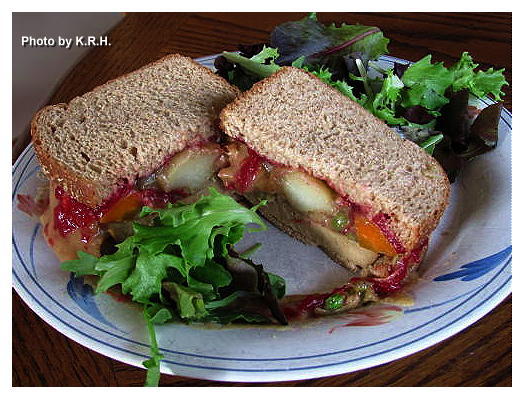
So this afternoon when lunchtime rolled around I very excitedly bounced into my kitchen eager to try for the first time ever a post holiday sandwich. I heated the tofurky, a few spoonfuls of mushroom gravy and a scoop of leftover vegetables. Left the cranberry sauce cold though I suppose you could heat that also and then grabbed the wheat bread to assemble. When I finally sat down to take a bite out of my creation it was as if all the goodness of Thanksgiving exploded into my mouth. This sandwich has all the things you love about Thanksgiving rolled up into one big, delicious, decadent treat. My only complaint is that there should have been more stuffing. I suggest if you’re a stuffing lover you make an extra dish of stuffing to serve alongside your tofurky roast, and be sure to leave some extra for your sandwich the following day!


The Obligatory Post-Holiday Leftover Tofurky Sandwich.

2 thin slices roast tofurky
2-3 generous spoonfuls of mushroom gravy
1 scoop of mashed assorted roast vegetables or mashed potatoes
1 generous spoonful of cranberry sauce
2 slices whole what bread
1-2 generous spoonfuls of stuffing of choice (optional if you have any leftover available)

- On a plate heat your tofurky, vegetables and stuffing in the microwave until warmed through but not piping hot. About 1 minute and 30 seconds.

- In separate dish heat your mushroom gravy, until warmed through. About 1 minute.

- Place sliced tofurky on 1 slice of wheat bread. Top with optional stuffing, roasted vegetables or mashed potatoes and then pour gravy over top. Slather the cranberry sauce over the second slice of bread and press on top of the sandwich.

- Slice sandwich in half to make it easier to eat. Caution sandwich will be messy but it’s oh so worth it! Serve with a side salad of mixed greens and enjoy!

PS: This is definitely comfort food not health food, but then what are the holidays about if not comfort? Thanksgiving only comes once a year right, allow yourself to indulge a bit!
PPS: Regrettably I neglected to take pictures of the full Tofurky meal from last night. This has a lot to do with the fact that we ate rather late, and both of us were too hungry to wait for my photo shoot to be over. Appologies for that as I now wish I’d taken photos of every dish to accompany this post, and so you could see what a roasted tofurky looks like - the picture on the box is a little less then appetizing in my opinion - as well as see Alicia’s cranberry sauce and Isa’s Stewed and Sauteed Collards. C’est la Vie! Next time I promise.

Sunday, November 20, 2011

Baking Powder Biscuits with White Bean and Tempeh Sausage Gravy....


Can I confess something to you? Before I moved to the U.S. I’d had never heard of biscuits and gravy before. Well, I knew what biscuits were, and I knew what gravy was of course, but I’d never heard of the two being served together, and certainly not for breakfast. Yet it’s a dish that everyone I know here grew up with. Interestingly Biscuits and Gravy emerged as a popular regional dish after the American Revolutionary War, precisely because it was cheap, hearty and used ingredients that were readily available to the average person. As far as I know there is no Canadian equivalent, or at least not that I ever saw growing up. So it wasn’t until after I’d moved to the U.S. that I tried this dish for the first time.

Biscuits Fresh Out of the Oven


I’d heard plenty about it by that time, lots of people raved about it, even going so far as to label it the quintessential American breakfast, so I was interested, and curious, though I have to say I was also skeptical. I was never really a meat in the morning kind of person, and for those of you who don’t know the gravy for traditional biscuits and gravy is made with ground pork sausage or ground beef, including the greasy drippings from said meat, mixed with flour, milk and a dash of this or that. I’ve also never really been a fan of milk, and honestly the idea of cooking ground beef in milk kind of put me off. The smell alone was horrendous, and then when I saw the finished product I thought it looked - advanced apologies for any former biscuits and gravy lovers - a lot like dog vomit. In any case it looked a lot more like something that should be coming out of you rather then going in, but scepticism aside I decided to give it a try. Well, I couldn’t get through more then a couple of bites before I wanted to retch - which is surprisingly exactly the reaction I had upon my first and only encounter with another popular American dish, Chicken Fried Steak. - There was absolutely nothing about it that I found appetizing aside form the biscuits and so I stared in awe as my husband continued to shovel mouthfuls of it into his mouth. Really the idea of cooking greasy ground beef in milk just gives me the shivers. Suffice to say I never ate biscuits and gravy again, nor had I any interest or intention of trying to veganize the dish.


Then last Thursday rolled around, and well you see I’ve set myself a little project. Since finishing vegan mofo I realized something. Though I own at least 20 or more cook books, I only ever use a handful of them. I’d never realized before that there are only about five or six books I consider to be me ‘go to’ cook books, while the rest I leave neglected in a pile to collect dust. After vegan mofo I decided to set myself the challenge of cooking at least 10 recipes from every one of my virtually unused cook books. I don’t have a specific time frame in mind, it’s just go at my own pace, and ever once and a while I’m sure I’ll share a recipe with you - as I’m doing today - So last Wednesday I was looking for something special to cook for my husband for breakfast on Thursday since he had that day off, and I happened upon the Baking Powder Biscuits with White Bean and Tempeh Sausage Gravy recipe from "Vegan with a Vengeance" As already stated my experience with biscuits and gravy was so bad that I’ve never thought about them for even a second since that day, but my husband has always been a fan. Since going vegetarian/vegan he hasn’t had them obviously, nor has he had a vegan version. Thinking it might be a nice treat for him I decided to take a moment to look over the recipe, and I don’t know something about it just started calling to me. The idea of blending up a can of white beans with vegetable broth to make a thick savory gravy, seasoned with Italian spices and loads of sage just got my mouth watering. I actually really like the idea of using white beans to make sauces, gravies and soup bases because they’re rich and creamy. I also love sage but don’t use it often enough.

White Bean and Tempeh Sausage Gravy


Now, tempeh I’m not such a fan of as I’ve mentioned before but I thought I’d give Isa the benefit of the doubt here. I liked the sound of her recipe for Tempeh Sausage Crumbles. It was relatively quick, and super easy, used ingredients I had on hand, and I’m always curious to try tempeh cooked in new ways to see if I like it any better. I think simmering it in water for twenty minutes as you do in this recipe goes a long way in cutting out that awful bitterness, while also loosening the tempeh up so that it can soak up other flavors. Once the water has been absorbed you then brown the tempeh in olive oil, and soy sauce and season it with garlic, oregano, marjoram, basil, sage, and fennel. I don’t particularly like fennel so instead of using 1 tbsp of fennel seed I used ½ tbsp and added 2 more cloves of minced garlic then required, and honestly it was fabulous!

Once your tempeh is all browned you add your blended gravy into the pan, warm it through then serve it over the biscuits, which by the way were exquisitely soft and doughy with just a slightly crisp outer edge just as I like them. I was completely blown away by this meal. I ate three biscuits and three generous scoops of gravy and I am more then willing to make this again. The tempeh sausage tasted just like what I remember Italian sausage to taste like - something else I never liked, but surprisingly don’t mind veganized - except a little milder, and not the slightest bit greasy. The fennel wasn’t overpowering and the sage was absolutely perfect, although I had to use dried sage because I didn’t have any fresh available. This breakfast couldn’t have turned out better. Although next time I think I might double the gravy recipe because I would have liked a bit more creamy liquid to soak my biscuits with.


Whether you were or weren’t a fan of biscuits and gravy I definitely recommend this recipe. If you were I imagine you’ll like this a lot, and If you weren’t you just might find yourself surprised. So if you own ‘Vegan with a Vengeance’ seriously, snap to it already!

PS: They taste good drizzled with a bit of Earth Balance then the gravy too! Yum1

Thursday, November 17, 2011

Thanksgiving - Reexamining Traditions....

Thanksgiving has always been my favorite holiday, but because modern Thanksgiving traditions focus so heavily on the consumption of turkey flesh, it can be the most difficult holiday to sanely maneuver as a vegan. Today Thanksgiving is all about the turkey, yet what few people realize is that Turkeys had virtually nothing to do with the first Thanksgiving in either Canada or the United States, and were not a common meal item during Thanksgiving until the Mid 20th century. In fact many of the things we consider Thanksgiving traditions today, from the spirit of the holiday to the food involved have little or no connection to the original celebration, and are complete myths. The Thanksgiving traditions that we are all familiar with today, have only been developed over the last two centuries.

In America there is actually very little known about the first Thanksgiving, and what we do know about it comes from only two sources. One a letter by Edward Winslow dated December 1621, the second a book by William Bradford written twenty years after the event took place. Though interestingly enough Bradford’s book was stolen during the revolutionary war, and didn’t resurface until 1854 so it had very little influence on shaping American Thanksgiving traditions. No where in either document do they write that turkeys were slaughtered for the actual Thanksgiving feast. In fact the only mention of turkey is from Bradford, who writes in his book only that the colonists hunted wild turkey’s during the autumn season. Though his book gives clues as to what may have appeared at the feast.

The animals killed for the first Thanksgiving were likely ducks, geese, various kinds of fish, and possibly deer. Though there is some speculation that because of the bounty of abundance brought in by the fall harvest, there would have been less meat, and more fruits and vegetables adorning the table. Interestingly many of the dishes we consider so familiar were entirely absent at the first Thanksgiving. Cranberry’s if they were used at all would have been used almost solely for their color because their tartness wasn’t desirable to the European settlers. It wasn’t for another fifty or so years that people began boiling fruit with sugar to make sauces and pies. Though had the settlers been privy to this trick it is unlikely that sugar would have been available anyway. Potatoes either regular or sweet were also not available at this time as cultivation of the popular root vegetable had not yet spread to North America. Pumpkins were also likely absent, but even if they had been available there was no flour so pumpkin pie would have been impossible, subsequently there were no ovens in which to bake a pie so it’s doubtful any pie at all was served for dessert. Another interesting fact is that there were no forks at the Thanksgiving feast.

There is also some controversy not only about whether or not the pilgrims actually first landed at Plymouth Rock, but also just how friendly their relationship with the Wampanoag Indians was. There are many stories and accounts of the European colonists stealing from and raiding the homes and ‘pantry’s’ of the Wampanoag. Taking their corn, beans and other harvest foods. It is also said that the Wampanoag weren’t originally invited to join in the festivities. That it was only after hearing gunfire from the settlers hunting rifles that the Wampanoag - thinking the settlers were preparing for war - appeared on the scene. Once they realized that they were mistaken and that it was a feast being prepared they returned to their homes to gather their people and the bounty of their harvest to share with the settlers.

Contrary to popular belief this first Thanksgiving really shouldn’t be labeled as such, but rather be called "The first Thanksgiving of the New World" Thanksgiving historically and traditionally has always been a celebration of the fall harvest. This tradition of celebrating the abundance that comes with autumn goes back as far as civilization and appears in some form or another in every culture in every country across the globe. The European settles likely celebrated fall harvest in some form in the years before their journey to the new world, making this ‘first Thanksgiving’ just a continuing tradition of something that was already familiar to them. Thanksgiving has little to no religious significance, in fact the European settlers while religious, never would have celebrated fall harvest in a religious manner, doing so would have been considered inappropriate. They actually had two separate fall traditions, the fall harvest which we know today as Thanksgiving, the celebration of food and feasting, and then an actual Thanksgiving which was spent in quiet reflection and fasting in the name of God. This second tradition was a solemn and serious affair as were most religious rituals and practices of that day. A very different kind of thanks giving then we are accustom today. For centuries afterwards Thanksgiving remained a religion-free celebration, and it wasn’t until the twentieth century that Thanksgiving began to take on a more religious significance at least in the United States.

So, how, you might wonder did our current traditions and notions of Thanksgiving come to be? Well the credit can almost solely be placed upon the persistence of one woman named Sarah Josepha Hale, who lived from 1788 to 1879. Hale was the editor of a very popular magazine. She is also the author of the novel Northwood: Life North and South, one of the first American books written by either gender about slavery. She is also famous for authoring the children’s nursery rhyme "Mary Had a Little Lamb."

Believing there were too few annual holidays celebrated in America, Hale embarked on a 40 year quest beginning in 1827 to make Thanksgiving a national holiday. Before becoming a national holiday Thanksgiving was only regularly celebrated in New England. While other states had harvest festivals, their traditions were sporadic and took place anywhere between the beginning of October to the end of January, and was relatively unknown in the South. She used her status as an author and the vehicle of her editors position to write romantic and idealistic tales of the First Thanksgiving, taking many liberties to better appeal to her readership, she also went so far as to include her own personal recipes for some of her favorite fall dishes in the magazine. Recipes including those for roasted turkey, stuffing and pumpkin pie, things that - as already mentioned - would not have been present at the first Thanksgiving, but subsequently are all things that we eat today as part of our ‘tradition.’

In her quest to make Thanksgiving a national holiday she wrote letters to five different American Presidents - Zachary Taylor, Millard Filmore, Franklin Pierce, James Buchanan, and Abraham Lincoln - as well as other officials. Virtually all of her letters went ignored, until her letter to Lincoln which was persuasive enough to convince him to support legislation establishing Thanksgiving as a national holiday in 1863. The new national holiday was considered at the time a unifying day after the stress of the Civil War. Interestingly prior to the addition of Thanksgiving the only national holidays celebrated in the United States were Independence Day and Washington’s Birthday.

However even as many of the myths Hale started began to seep into the culture’s collective consciousness, turkeys were not widely accepted as the picture perfect Thanksgiving meal until the mid twentieth century. You see wild turkeys - the kind of turkey the pilgrims would have eaten had they eaten any turkey at all - are adorned with dark plumage, and are thus dark skinned, meaning they have dark meat. Dark meat was unappealing and unappetizing to a great majority of consumers so to make turkey meat more desirable the Beltsville white was bred in 1947 at the behest of the National Turkey Federation. Since the white meat was more appealing to consumers, this is when turkey consumption went on the rise, increasing exponentially over the years. Turkey consumption continues to rise, and according to the USDA slaughter numbers an average of 240 million turkeys are killed each year, and anywhere from 22 to 40 million of those deaths occur at Thanksgiving, with another 22 million occurring at Christmas.

Canadian Thanksgiving traditions aren’t based in reality any more then the American ones. Various First Nations in Canada had long standing traditions celebrating in the bounty of the fall harvest dating back centuries before the European settlers arrived. Though the history of Thanksgiving as we sort of know it today can be traced back to the 1578 voyage of Martin Frobisher from England in search of the Northwest Passage. It was his intention to start a small settlement in the pressent Canadian territory of Nunavut and his fleet of fifteen ships was fitted with men and materials for exactly this purpose. However his expedition was plagued by ice and freak storms which at times had scattered his fleet, but upon rejoining at their anchorage Robert Wolfall an appointed preacher gave a sermon of thanks to God for their miraculous deliverance from danger, after which they celebrated.

Years later French Settlers having crossed the ocean and arrived in Canada with explorer Samuel de Champlain in 1604 and onwards, also held huge feasts of thanks. They even formed "The Order of Good Cheer" and happily shared their food with their First Nations neighbors.

After the Seven Years War ended in the 1763 handing over of New France to the British, the citizens of Halifax held a special day of Thanksgiving. Beginning in 1799 Thanksgiving days were observed though not held every year. After the American Revolution American refugees who were still loyal to Great Brittan moved from the newly independent United States into Canada bringing with them many of the traditions and customs of American Thanksgiving. Still celebrations varied across the country. Lower Canada and Upper Canada for example celebrated Thanksgiving in different ways and on different dates, usually coinciding with the ends of wars and rebellions. Following the rebellions when the two Canada’s had merged into a united Provinces of Canada Thanksgiving was only observed six times between the years of 1850-1865.

It wasn’t until 1879 that Thanksgiving Day began to be celebrated every year, though the date was initially a Thursday in November. The theme for Thanksgiving also changed each year to reflect an important event to be thankful for. In the early years it was for an abundant harvest, however after World War 1 Thanksgiving Day was combined with Armistice Day and celebrated on the Monday of the week in which November 11th occurred. In 1931 the two days once again became separate holidays, and in 1957 Thanksgiving was permanently set on the second Monday in October.

Interesting no? Another interesting little fact is that while Hale was no friend or savior to the Turkey she did have some other very noble ideas about what a Thanksgiving tradition should include. She originally envisioned that Thanksgiving would be about charity and generosity writing, "Let us consecrate the day to benevolence of action, by sending good gifts to the poor and doing those deeds of charity that will, for one day, make every American home the place fo plenty and of rejoicing." I guess some traditions stick better then others which is kind of my point in this writing.

We as people pick and choose our traditions and our beliefs. Our emotional attachments to ‘traditional Thanksgiving’ - as well as other cultural traditions - are incredibly powerful, and very often we try to justify them by citing historical accuracy. However historical accuracy plays no role in the Thanksgiving traditions of today, the idea is completely absurd. We continue to view turkeys as the quintessential Thanksgiving meal because that’s what we’ve been taught. We continue to eat turkeys because that’s what we grew up with, it’s what we’ve always enjoyed. At a very young age we are conditioned into a set of traditions, rituals and values, but often as we grow up we choose to ‘cherry pick’ those traditions, and values that best suits us, while leaving the rest behind. We choose to make Turkey our tradition but we can just as easily not choose it. It’s our ideals that shape our traditions, they’re not - or at least shouldn’t be - dictated by what people may or may not have eaten 400 years ago. That’s crazy if you think about it.

Our celebrations should reflect our values, and my values don’t jive with the mindless slaughtering of millions of beautiful animals whose flesh I have no nutritional requirement for. It’s important to remember that we can live our values and honor tradition at the same time. Remember that above all else Thanksgiving was a celebration of the fall harvest. We can easily, happily, healthfully and without murder celebrate in the countless bounty of fall. 22-40 million innocent and beautiful turkeys are slaughtered every year for this day of Thanks, but they don’t have to be. You can choose to celebrate kindness, you can choose to celebrate mercy, you can choose a gentler tradition.

This year live the values of compassion and celebrate a turkey free Thanksgiving.